Integrated infrastructure, software and services for secure, scalable agentic AI
BERLIN, Oct. 21, 2026 /PRNewswire/ -- ASUS today unveiled its Enterprise Agentic AI Solution, an integrated full-stack offering that brings together AI infrastructure, software and services to help enterprises deploy, govern and scale agentic AI from development to production. At GTC Berlin 2026, ASUS is showcasing the solution alongside its comprehensive agentic AI portfolio, spanning data center infrastructure and accelerated computing, AI development and workstations, intelligent edge systems and agent computers — delivering a unified foundation for the evolving AI journey from data center to desk and edge.
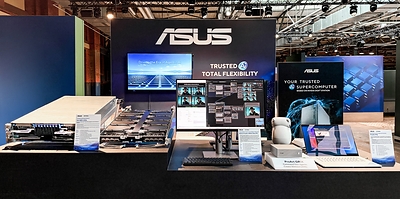
Rack-scale infrastructure for agentic AI
As agentic AI moves from experimentation to production, enterprises require infrastructure capable of supporting continuous perception, reasoning, and multi-step execution at scale. The ASUS Enterprise Agentic AI Solution integrates three core layers: ASUS AI HUB for fleet-wide agent registration, governance, and monitoring; NVIDIA AI Enterprise and the ASUS AI Software Stack for seamless orchestration and workflow integration; and ASUS AI servers and infrastructure — such as the full-stack ASUS AI factory platform powered by NVIDIA Vera Rubin NVL72, which is co-designed to deliver 30X-higher throughput per megawatt and 45X-lower token cost for agentic AI.
Together, these layers deliver a secure, reliable, and scalable foundation while simplifying infrastructure planning and enterprise integration. Through a streamlined configuration process based on model scale, performance targets, and operational requirements, ASUS helps customers in finance, healthcare, manufacturing, the public sector, and other regulated industries identify and deploy the ideal platform for their specific needs.
Enterprise-ready infrastructure for agentic AI
At the enterprise level, ASUS showcases a lineup of high-performance, scalable NVIDIA MGX servers built for agentic AI workloads, including the XA P2N-E2, a 2U AI server powered by NVIDIA Vera CPUs for next-generation agentic AI systems and the XA P8A-E14AXL, a high-density 6U system supporting eight liquid-cooled NVIDIA RTX PRO 6000 Blackwell Server Edition GPUs. The ASUS ESC8000 series extends support for demanding AI and accelerated computing workloads: the ESC8000-E12P supports NVIDIA RTX PRO 4500 Blackwell Server Edition GPUs for AI, data processing, and visual computing, while the ESC8000A-E13X combines NVIDIA RTX PRO 6000 Blackwell GPUs with NVIDIA ConnectX-8 SuperNICs for high-speed GPU-to-GPU connectivity.
Extending agentic AI from data center to physical world
ASUS showcases practical physical AI workflows spanning simulation, validation and real-world deployment at the edge. The PE3000N, powered by NVIDIA Jetson T5000 module build on NVIDIA Jetson Thor, delivers up to 2,070 FP4 TFLOPS of AI performance and 128GB of memory in a compact, deployment-ready form factor, while the PE6000G serves as a workstation-grade AI and simulation platform for industrial environments. Together, they enable advanced perception, reasoning and action across applications including robotics, autonomous machines and intelligent video analytics, connecting development and validation with reliable edge execution across NVIDIA's robotics ecosystem.
Agent computers extend AI from development to the edge
Beyond the data center, ASUS delivers NVIDIA-powered AI infrastructure across the edge, workstation, and PC, giving organizations a flexible foundation to build, deploy, and scale production-ready agentic AI.
The ASUS ExpertCenter Pro ET900N G3 brings data center-level performance to the desk, built on the NVIDIA GB300 Grace Blackwell Ultra Desktop Superchip with 748GB of coherent memory and the full NVIDIA AI software stack. It enables businesses to securely develop, train, and deploy large language models and generative AI on-premises while maintaining full control over their data.
Making agentic AI more accessible on the desktop, the ASUS Ascent GX10 is based on the NVIDIA DGX Spark platform and powered by the full NVIDIA AI software stack. Now available with both 64GB and 128GB of unified memory, the Ascent GX10 gives AI developers greater flexibility across a wide range of local AI workloads. The desktop AI supercomputer supports models ranging from approximately 30-35 billion parameters to models of up to 200 billion parameters, enabling advanced AI development, prototyping, fine-tuning, and inference. As workloads grow, up to four systems can be easily clustered using NVIDIA Sync Cluster Assistant.
The ProArt P16 and P14 laptops, powered by NVIDIA RTX Spark and delivering up to 1 petaflop of AI performance with up to 128GB of unified memory, combine high-performance AI computing with ASUS Lumina Pro OLED displays featuring up to 1,600 nits peak brightness. At 12.9mm and 1.77kg, ProArt P16 is the thinnest 16-inch ProArt laptop to date. ProArt P14 measures 13.9mm and weighs 1.48kg, making it the lightest ProArt laptop currently available. High-capacity batteries — up to 99.9Wh for P16 and 90Wh for P14 — support extended mobile creative workflows. ASUS has also partnered with Hermes Agent and ComfyUI to bring industry-validated workflow and agent-connected creative tools directly to users' PCs, enabling local-first, cloud-flexible experiences for generative AI creation and AI-assisted development, with the flexibility to integrate cloud services when needed.
For always-on AI at the desktop, the ProArt GR1X mini PC packs NVIDIA RTX performance into a compact 150x150x51mm chassis. It features a 218-blade dual-fan cooling system and seven-level fan control, engineered to support sustained 24/7 operation with low acoustic levels. With support for dual M.2 SSD storage, 10GbE, WiFi 7, Bluetooth 5.4, and up to four 4K displays, ProArt GR1X enables autonomous agents to handle complex 3D rendering and creative workflows in the background overnight.
Experience ASUS at NVIDIA GTC Berlin 2026
ASUS welcomes visitors to Booth #3039 at Station Berlin throughout GTC Berlin 2026 to explore its latest AI solutions across infrastructure, edge computing, and professional applications. For a deeper look at the ASUS Edge-to-Cloud AI portfolio — including edge AI systems and NVIDIA HGX- and RTX PRO-based enterprise infrastructure — visitors can also experience the ASUS VIP Room at the W3 Hub, open October 20-22. More information is available here.
AVAILABILITY & PRICING
ASUS server products are available worldwide. Please contact your local ASUS representative for further information.
 View original content to download multimedia:https://www.prnewswire.co.uk/news-releases/asus-unveils-enterprise-agentic-ai-solution-and-full-stack-agent-computer-at-nvidia-gtc-berlin-2026-302915387.html

Sandro Brotz kehrt dem Schweizer Radio und Fernsehen den Rücken und wechselt Anfang 2027 zur Boulevardzeitung «Blick». Der 56-jährige Journalist, derzeit Moderator und stellvertretender Leiter der Polit-Talksendung «Arena», wird SRF Ende Januar 2027 verlassen. Bis voraussichtlich Mitte Januar führt er weiterhin durch die «Arena». Beim zum Ringier-Konzern gehörenden «Blick» soll Brotz einen neuen Video-Podcast aufbauen und moderieren, der mehrmals pro Woche Themen aus Politik, Wirtschaft und Gesellschaft aufgreift.
Der Schritt markiert das Ende einer knapp 15-jährigen SRF-Ära für Brotz. Seit seinem Wechsel nach Leutschenbach im Juni 2012 prägte er zunächst als Moderator der investigativen Sendung «Rundschau» das Programm, später zusätzlich als Gastgeber des «Rundschau Talk». 2019 übernahm er schliesslich die «Arena» von Jonas Projer. Als Grund für den Wechsel nennt Brotz die Möglichkeit, bei «Blick» ein neues Format mitzuentwickeln und damit über die Rolle des klassischen Moderators hinauszugehen. Ganz neu ist das Ringier-Umfeld für ihn nicht: Vor seiner SRF-Zeit war er bereits unter anderem stellvertretender Chefredaktor des «SonntagsBlick».
Der Abgang von Brotz wirft bei SRF unmittelbar die Nachfolgefrage auf. Als Topfavorit galt zuletzt sein Kollege Mario Grossniklaus, der seit 2024 einmal im Monat die «Arena» moderiert und damit Brotz entlastet. Der 49-Jährige hat dieser Spekulation nun jedoch eine klare Absage erteilt. Auf Linkedin schrieb Grossniklaus, er werde sich nicht auf die Nachfolge seines «geschätzten Kollegen» bewerben. Stattdessen wolle er sich auf seine Aufgaben in der Wahlleitung von SRG und SRF konzentrieren – eine Funktion, die er als «grösste und spannendste Aufgabe» seiner bisherigen Karriere bezeichnet.
Mit der Absage von Grossniklaus bleibt offen, wer Brotz ab etwa Mitte Januar beerben wird. SRF verweist darauf, man wolle sich vorerst auf eine geordnete Übergabe der «Arena» konzentrieren. Der Wechsel von Brotz reiht sich ein in eine Serie prominenter Abgänge von SRF in Richtung Dufourstrasse: Bereits zuvor hatten unter anderem Reto Scherrer, Steffi Buchli, Christine Maier, Hannes Britschgi und der frühere «Arena»-Moderator Jonas Projer den Schritt zum Ringier-Konzern gewagt. Die Motive reichen von besseren Angeboten bis hin zum Wunsch, den eigenen Namen in neuen Rollen und Formaten zu positionieren – mit sehr unterschiedlichem Ausgang.