MUNICH, June 23, 2026 /PRNewswire/ -- GCL System Integration Technology Co., Ltd. ("GCL SI" or "the Company") has announced at Intersolar Europe 2026 held from June 23 to 25 in Munich to officially establish back-contact (BC) cell technology as the core strategic pillar of its next-generation photovoltaic roadmap, as a response to the rising demand for high-efficiency, aesthetically driven solutions. It also unveiled the GPC 3.0 full-screen all-black module at one of the most influential solar industry trade fairs worldwide.
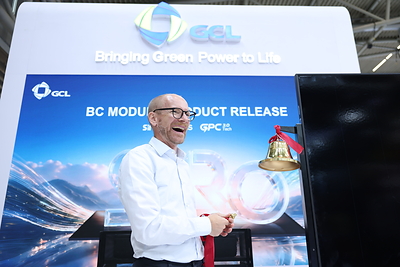
As China's solar sector faces mounting efficiency bottlenecks and increasingly diverse end-market demands, the shift to BC technology is driven by both evolving market needs and the company's accumulated expertise in passivation and contact techniques.
"BC is the ultimate architecture for crystalline silicon cells," said GengWeng Huang, Executive Dean of GCL SI's Cell Research Division. "We've already explored TOPCon and HJT extensively, but both are reaching their physical limits. BC is opening a broader window for future efficiency gains."
GCL SI's GPC (Graphical Precise-doping Passivation Contact) product line is its flagship BC technology development. GPC 3.0 targets the premium distributed segment of residential rooftops, C&I rooftops, and BIPV-style applications, where full-screen all-black aesthetics, higher energy yield, and stronger reliability are increasingly valued. GCL SI describes GPC 3.0 as a high-efficiency BC-based module designed to deliver greater real-world rooftop value.
Notably, GCL SI confirmed that the first containers of GPC 3.0 modules are already on their way to Europe, marking the beginning of its commercial rollout in the European distributed solar market.
The GPC residential full-screen all-black modules offer a proven benchmark: 475–500 W output, 23.27%–24.05% efficiency, dimensions of 1,800 × 1,134 × 30 mm, a 30-year linear power warranty with 0.35% annual degradation, and a 30-year product warranty. GCL SI has indicated that GPC 3.0 is designed to further enhance both efficiency and reliability beyond this baseline.
According to GCL SI, GPC 3.0 integrates several upgraded technologies including MAX design, advanced passivation, multi-layer gradient dielectric films, GPC metallization, and FBR granular silicon, to boost module efficiency, durability, and suitability across distributed scenarios. The technology offers four core advantages:
Looking ahead, GCL SI is committed to driving the global large‑scale adoption of BC technology to support worldwide carbon neutrality goals. With GPC 3.0 as a strategic cornerstone, the company will continue pushing efficiency boundaries and low‑carbon innovation across distributed solar applications, and to build a cleaner, more resilient energy future.
 View original content to download multimedia:https://www.prnewswire.co.uk/news-releases/gcl-si-officially-launches-back-contact-modules-at-intersolar-europe-2026-302808216.html

Die Einigung zwischen den USA und dem Iran auf ein Rahmenabkommen zur Beendigung des Iran-Kriegs sorgt in der Handelsschifffahrt für vorsichtige Erleichterung. Besonders im Fokus steht die Straße von Hormus, eine der wichtigsten Seepassagen für den weltweiten Öl- und Flüssiggas-Handel. Seit Beginn des Konflikts Ende Februar ist die Meerenge weitgehend blockiert, zahlreiche Handelsschiffe sitzen im Persischen Golf fest. Nun soll die Passage nach der geplanten Unterzeichnung des Abkommens wieder geöffnet werden.
US-Präsident Donald Trump kündigte an, dass die Straße von Hormus nach dem Abschluss der Vereinbarung wieder für den Verkehr freigegeben werden solle. Die Unterzeichnung ist für Freitag in Genf vorgesehen. Für die deutsche Handelsschifffahrt wäre dies ein entscheidender Schritt zur Normalisierung. „Die Signale aus den Gesprächen zwischen den USA und dem Iran machen auch der Schifffahrt Hoffnung“, sagte Martin Kröger, Hauptgeschäftsführer des Verbands Deutscher Reeder (VDR). Zugleich mahnte er, es müsse sich erst zeigen, ob die Passage dauerhaft sicher befahrbar sein werde. Man sei „vorsichtig optimistisch“.
Die Branche hat allen Grund, auf rasche Entspannung zu hoffen. Nach Angaben des VDR sitzen aktuell noch 46 Schiffe deutscher Reedereien mit rund 1.000 Seeleuten im Persischen Golf fest. Die Blockade der Meerenge trifft nicht nur die Reedereien, sondern bremst den globalen Energiehandel. Die UN-Sonderorganisation für Seeschifffahrt (IMO) begrüßte die Einigung ausdrücklich. Seit Ausbruch des Konflikts wurden der IMO zufolge 46 Angriffe auf Handelsschiffe in der Region bestätigt, bei denen 14 Seeleute ums Leben kamen.
Trotz der diplomatischen Fortschritte sehen Branchenverbände die Lage in der Region weiter kritisch. Der internationale Schifffahrtsverband Bimco bewertet die Sicherheitslage in der Straße von Hormus auch nach Bekanntwerden des Rahmenabkommens als instabil. Eine Durchfahrt bleibe sehr riskant, heißt es aus dem Verband. Für Reeder und Charterer stellt sich damit die Frage, wie schnell und in welchem Umfang sie ihre Routen wieder über die Meerenge führen können – oder ob Ausweichrouten zumindest mittelfristig bestehen bleiben müssen.
Für den Moment überwiegt in der Schifffahrt die Hoffnung, dass die geplante Vereinbarung in Genf die Voraussetzungen für eine nachhaltige Entspannung an einem der neuralgischsten Punkte des globalen Seehandels schafft. Ob und wie schnell sich die Zahl der festliegenden Schiffe reduziert und sich die Risikoeinschätzungen der Versicherer und Verbände anpassen, dürfte entscheidend dafür sein, wann sich der Verkehr durch die Straße von Hormus wieder weitgehend normalisiert.