MEXICO CITY, June 9, 2026 /PRNewswire/ -- A major football tournament spanning the United States, Canada and Mexico (11 June – 19 July) is set to drive a surge in international travel to North America this summer, with Trip.com booking data revealing year-on-year growth of nearly 70% across the 16 host cities.
As football fans across Asia-Pacific and Europe commit to their summer plans months in advance, the data paints a vivid picture of where travellers are going, how long they are staying, and exactly what sort of trip they are on.

The Football Effect: Demand Nearly Doubles in June Versus July
The scale of football-driven travel demand becomes clear when the two tournament windows are compared directly. During the Group Stage period, total international bookings to host cities are up almost 70% year-on-year. By the Knockout Rounds, that growth rate falls to around 40%, still substantial, but a sharp contrast that reflects the concentrated urgency of fans following their national teams during the opening weeks of competition.
The Group Stage is the must-travel moment. Fans are not waiting to see how their teams perform. They are booking early, decisively, and around the fixtures that matter most to them.
Japan Leads the World
No market tells the 2026 story more dramatically than Japan. Japanese fans are booking flights to host cities at a rate +250% year-on-year for the Group Stage, more than two and a half times the volume of the previous year and more than double the growth rate of any European nation in the same period. Even for the Knockout Rounds, Japan records over +100% growth, the highest of any market analysed.
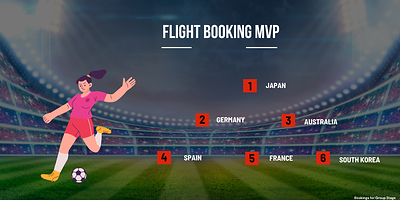
This is not a general holiday demand dressed up in football colours. It is fixture-following travel at its purest. Japan's Group Stage matches are scheduled across Dallas and Monterrey, and the booking data mirrors this precisely. Dallas is Japan's single most-booked host city for flights in the Group Stage, a city that barely registered on the Japanese outbound travel map twelve months ago. By the Knockout Rounds, when fixtures shift, Los Angeles becomes Japan's top destination.
The Japan story does not stop at flight bookings. Japanese travellers are also the most adventurous when it comes to itinerary planning. Over 30% of Japanese Group Stage travellers book more than one host city, the highest multi-city rate of any market by a significant margin. Close to 10% cross two or more host countries during the Group Stage, a direct consequence of Japan's fixtures being distributed across North America.
Japan's top multi-city pairings during the Group Stage tell the story clearly: Dallas + Los Angeles, Dallas + Monterrey and Mexico City + Monterrey. These are not sightseeing routes but carefully planned travel itineraries around match schedules.
The Mexican Cities: The Less Talked About Accommodation Story
While US and Canadian host cities attract predictable attention, the Mexican venues Guadalajara, Mexico City and Monterrey are generating some exciting booking results across the tournament.
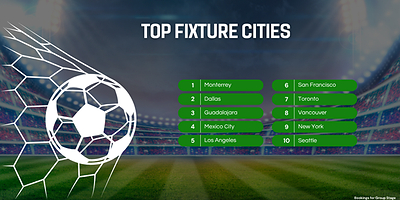
Monterrey's hotel bookings are up over 40X year-on-year during the Group Stage. Guadalajara is up over 10X. Mexico City is up over 150%. These are not incremental gains but represent a near-total transformation of international accommodation demand in cities that were barely on the inbound travel radar before.
The driver is fixture scheduling. Japan, South Korea, and Australia's schedules are drawing fans into a North American travel corridor that extends deep into Mexico.
Dallas tells a complementary story from the US side. Hotel bookings in Dallas are up by more than 1400% during the Group Stage, driven overwhelmingly by Japanese and Korean demand.
The Football Road Trip Is a Myth
Despite the romance of a cross-continental football adventure, the data tells a more pragmatic story. The majority of fans book travel to just one host destination per trip.
Multi-market travel is highest among Japanese fans in the Group Stage and lowest among South Korean fans in the Knockout Rounds.
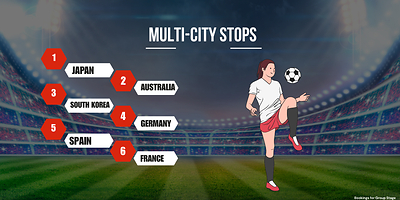
In every other market and period, single-market trips dominate, with travellers focusing on 1 or more cities within a single North American country.
Lead Times and Loyalty: The Forward Planners vs. The Late Deciders
The gap in booking behaviour between the Group Stage and the Knockout Round is fascinating. Travelling fans booking for July, the later, more uncertain tournament phase, are planning further in advance than those booking for June.
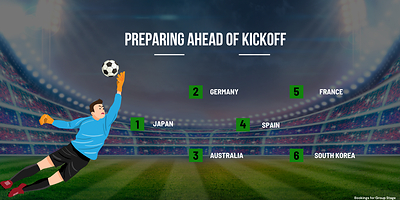
For the Group Stage, flight booking lead times across markets range from 80 to 95 days. For the Knockout Rounds, the same markets are booking 96 to 127 days out.
Germany leads both periods, booking hotels an average of 138 days before travel. That's nearly five months in advance of a match whose participants are not yet confirmed.
This pattern suggests that Knockout Round travellers represent a highly committed segment, with fans hoping their team will advance. Attractions bookings tend to show the opposite trend, with shorter lead times across all markets, suggesting fans finalise their non-football plans on a wait-and-see basis.
Beyond the Stadiums: What Fans Are Doing When the Final Whistle Blows
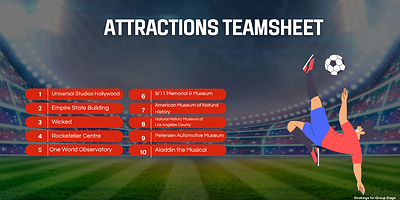
The most-booked attraction is Universal Studios Hollywood, which tops the rankings. The Empire State Building, Rockefeller Centre, and the American Museum of Natural History dominate New York bookings, while Japanese travellers show a distinct appetite for Broadway, with Wicked and Aladdin the Musical both featuring in the top ten attractions overall.
Trip Duration: From Short Breaks to Extended Holidays
Average trip lengths vary dramatically by market. Japanese travellers take the shortest trips, averaging just 8 days in the Group Stage and 11 days in the Knockout Rounds, reflecting a fixture-focused, time-efficient approach. Spanish fans take the longest, averaging 24 days in the Group Stage and 17 days in July.
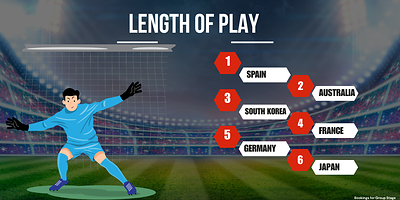
Australian fans average 23 days in the Group Stage before falling to 18 days in July. French fans remain consistent at 18 days across both periods. The relative stability of European trip durations across both windows suggests that these travellers are building fixed-length North American itineraries centred on football.
Hotel Preferences: Budget Dominates, But Premium Emerges in July
Across most markets, 3-star and 4-star hotels account for the vast majority of bookings, with 5-star demand showing single-digit growth. Japan is the most budget-conscious, with over 61% of Group Stage hotel bookings at the 3-star level. South Korea is the most luxury-oriented in the Group Stage.
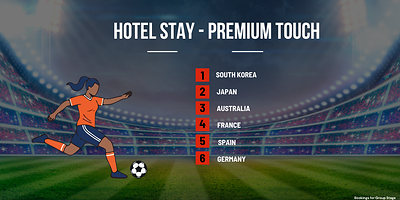
In the Knockout Rounds, 5-star demand increases across almost every market compared to the Group Stage. France leads the way with the largest increase in 5-star hotel bookings.
New York dominates as the preferred city for 4-star and 5-star bookings across the majority of markets in both periods, cementing its status as the tournament's prestige destination.
About Trip.com
Trip.com is an international one-stop travel service provider, available in 27 languages across 48 countries and regions in 44 local currencies. Offering an extensive hotel and flight network of more than 1.7 million hotels and flights from over 680 airlines, along with over 350,000 in-destination activities, Trip.com covers 3,500 airports in 220 countries and regions. Trip.com's world-class 24/7 multilingual customer service helps to 'create the best travel experience' for its millions of customers worldwide. To book your next trip, visit Trip.com.

 View original content to download multimedia:https://www.prnewswire.co.uk/news-releases/global-football-tournament-drives-travel-surge-with-group-stage-booking-growth-nearly-double-knockout-rounds-tripcom-data-302794662.html

Der US-Datenkonzern Palantir hat in der Schweiz eine deutliche juristische Niederlage erlitten. Das Handelsgericht Zürich wies 22 von 23 beanstandeten Passagen in zwei kritischen Artikeln des Online-Magazins «Republik» zurück. Lediglich eine einzelne Formulierung muss die Redaktion korrigieren. Palantir und seine Schweizer Tochtergesellschaft wollten gerichtlich durchsetzen, dass umfangreiche Gegendarstellungen publiziert werden; dieses Anliegen ist nun weitgehend gescheitert. Nach dem Urteil muss der Konzern zudem den überwiegenden Teil der Verfahrenskosten tragen.
Ausgangspunkt des Rechtsstreits waren Recherchen, die im Dezember 2025 nach rund einjähriger Arbeit erschienen. Das Projekt von «Republik» und dem Recherchekollektiv WAV beleuchtete, wie Palantir über mehrere Jahre versucht hatte, bei Bundesstellen und dem Schweizer Militär Aufträge zu erhalten – ohne Erfolg. Die Journalisten werteten dazu Dutzende Gesuche nach dem Öffentlichkeitsgesetz sowie interne Unterlagen aus und kamen zum Befund, dass das Unternehmen trotz einer mehrjährigen Präsenz in der Schweiz keinen einzigen Regierungsauftrag gewinnen konnte. Diese Erzählung eines «Scheiterns» auf dem Schweizer Markt war nach Darstellung der beteiligten Reporter Auslöser für Palantirs juristische Offensive.
Die Redaktion hatte dem Unternehmen nach eigenen Angaben vor Veröffentlichung ausführliche Fragen geschickt und Führungskräfte interviewt. Palantir verlangte darüber hinaus eine detaillierte, punktweise Replik im Magazin, die über den Umfang der ursprünglichen Recherche hinausgegangen wäre. Als «Republik» dies ablehnte, reichte der Konzern Klage ein. Das Zürcher Handelsgericht stellte nun klar, dass nur eine von 23 umstrittenen Passagen eine Gegendarstellung erfordert. Damit bestätigt das Urteil, dass der Großteil der Berichterstattung über Palantirs vergebliche Akquisitionsversuche bei Schweizer Behörden auf einer zulässigen Auswertung amtlicher Dokumente beruht.
Palantir ist international vor allem durch den Einsatz seiner Software in militärischen und nachrichtendienstlichen Kontexten bekannt. Seit 2022 stellt das Unternehmen Plattformen zur Verfügung, die ukrainische Behörden und Streitkräfte bei der Auswertung von Lagebildern, der Zielidentifikation und der Logistik unterstützen. Die Systeme werden außerdem von US-amerikanischen und verbündeten Diensten im Nahen Osten genutzt, um iranische Aktivitäten etwa in Raketenprogrammen, beim Einsatz von Drohnen oder in Cyberoperationen zu analysieren. Direkte Geschäftsbeziehungen mit dem Iran bestehen nach Unternehmensangaben aufgrund von US-Sanktionen nicht. Das Zürcher Urteil könnte über die Schweiz hinaus Signalwirkung haben, nachdem die Recherche bereits in anderen europäischen Staaten Debatten über Nutzen und Notwendigkeit der Palantir-Technologie im staatlichen Bereich angestoßen hatte.