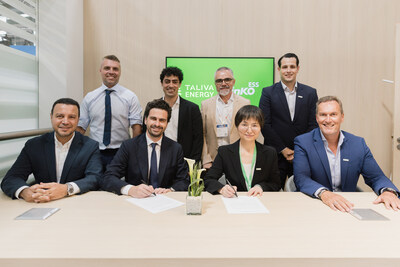
MUNICH, July 2, 2026 /PRNewswire/ -- Recently, Jinko ESS, a leading global energy storage company and a subsidiary of JinkoSolar Co., Ltd., and Taliva Energy, a clean energy company focused on full-scope energy storage solutions and large-scale energy infrastructure in Romania and Türkiye, with a growing presence across Europe, officially signed contracts covering 400MWh of battery energy storage system (BESS) projects across multiple utility-scale developments in Eastern Europe. The signing marks a significant milestone in the strategic cooperation between the two companies and demonstrates their shared commitment to accelerating the deployment of large-scale energy storage solutions that support Europe's clean energy transition.
As renewable energy penetration continues to increase across Europe, battery energy storage has become a key enabler of grid stability, renewable energy integration, and power system flexibility. Utility-scale storage projects require not only high-performance technology, but also trusted partnerships capable of delivering reliable products, efficient project execution, and long-term operational support. The growing cooperation between Jinko ESS and Taliva Energy reflects the increasing market demand for proven energy storage solutions that create long-term value for developers and grid operators.
The signed portfolio represents 400MWh of battery energy storage capacity across several projects, further strengthening both companies' positions in the rapidly expanding European energy storage market. These projects will contribute to enhancing grid flexibility, increasing renewable energy utilisation, improving energy resilience, and supporting the transition towards a more sustainable and reliable electricity system.
Anita Li, Vice President of Jinko ESS, said: "At Jinko ESS, we believe the future of energy requires both innovative technology and trusted local partnerships. The expansion of our cooperation with Taliva Energy is an important step in supporting Europe's energy transition by delivering reliable, scalable, and high-performance energy storage solutions where they are needed most."
Mario Dalsarfati, CEO of Taliva Energy, added: "Energy storage is becoming one of the most critical pillars of Europe's energy transition. For Taliva Energy, this 400MWh portfolio represents more than a project milestone; it reflects our ambition to build reliable, bankable, and long-term energy infrastructure across Europe. By combining Taliva Energy's project development and market execution capabilities with Jinko ESS's advanced technology and global experience, we aim to deliver high-value BESS projects that support grid flexibility, renewable energy integration, and a more resilient energy future."
The signing ceremony, held during Intersolar Europe, highlights the continued growth of the partnership and reinforces both companies' commitment to advancing large-scale battery energy storage deployment across Europe.
As an energy storage system solutions provider, Jinko ESS will continue to work closely with strategic partners such as Taliva Energy to deliver reliable products, advanced system integration, efficient project delivery, and comprehensive lifecycle services, providing a stronger, more flexible, and sustainable foundation for the global energy transition.
Photo - https://mma.prnewswire.com/media/3003063/12077.jpg
 View original content:https://www.prnewswire.co.uk/news-releases/jinko-ess-and-taliva-energy-sign-400mwh-energy-storage-project-portfolio-302816573.html

Forschende der Universität Zürich (UZH) haben einen Ansatz entwickelt, mit dem sich akuter Schlafmangel im Speichel nachweisen lässt. In einer aktuellen Studie identifizierte das Team um Thomas Krämer vom Institut für Rechtsmedizin eine Art metabolischen Fingerabdruck, der starke Übermüdung zuverlässig anzeigt. Die Resultate wurden im Fachmagazin „Journal of Proteome Research“ veröffentlicht und von Krämer als „Meilenstein für die forensische Forschung“ bezeichnet.
Für die Untersuchung rekrutierten die Wissenschaftler 20 gesunde junge Männer, die normalerweise sieben bis neun Stunden pro Nacht schlafen. Die Probanden durchliefen drei Szenarien: eine Nacht komplett ohne Schlaf, vier Nächte mit jeweils zwei Stunden weniger Schlaf als üblich sowie eine Kontrollbedingung mit rund acht Stunden Schlaf. Nach jeder Phase wurden Speichelproben entnommen und mittels hochauflösender Massenspektrometrie analysiert. Mithilfe von maschinellem Lernen suchte das Team nach molekularen Mustern, die spezifisch auf akuten Schlafentzug hinweisen.
Die Auswertung ergab, dass starke Übermüdung rund zehn Prozent aller Biomoleküle im Speichel beeinflusst. Aus zehntausenden gemessenen Molekülen filterten die Forschenden schließlich zehn spezifische Biomarker heraus, die als Signatur für akuten Schlafmangel dienen könnten. Diese erstmals im Speichel identifizierten direkten Marker für Übermüdung unter alltagsnahen Bedingungen gelten aus Sicht der UZH als Grundlage für neue diagnostische Verfahren.
Langfristig zielt das Projekt auf die Entwicklung eines Schnelltests, der vor Ort eingesetzt werden könnte – etwa im Strassenverkehr, in sicherheitskritischen Berufen oder bei der forensischen Abklärung von Unfällen. Die Forschenden betonen jedoch, dass es sich derzeit um eine Grundlagenstudie mit einer kleinen und homogenen Probandengruppe handelt. Bevor ein solcher Speicheltest in der Praxis Anwendung findet, seien umfangreichere Untersuchungen mit grösseren und vielfältigeren Bevölkerungsgruppen erforderlich.



