ULAANBAATAR, Mongolia, Aug. 24, 2026 /PRNewswire/ -- From August 17 to 28, 2026, the 17th session of the Conference of the Parties to the United Nations Convention to Combat Desertification (UNCCD COP17) is being held in Ulaanbaatar, Mongolia. During the conference, LONGi participated in several side events, systematically presenting the enormous potential of PV technology to enhance the resilience of global food supply, and officially released its solutions for PV-powered food security.
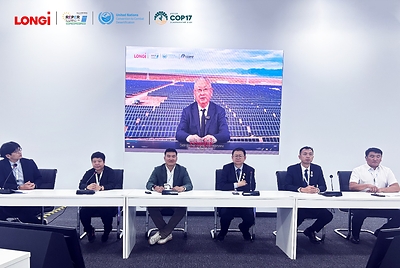
At a side event titled "From Desert to Asset – Comprehensive Solutions for Integrated PV-Based Ecological Restoration," co-hosted by the School of Social Sciences of Tsinghua University and the China Green Foundation, Li Zhenguo, founder and Chief Technology Officer of LONGi, joined via video link and noted that traditional food production relies heavily on natural photosynthesis and climatic conditions. Extreme weather events such as droughts and floods have severely impacted agricultural production, and global climate change is placing unprecedented pressure on an already fragile food supply system. However, as costs decline, PV technology can not only reduce carbon emissions but also offer a new solution for enhancing the resilience of global food supply.
Li Zhenguo recently published a forward-looking Perspective article titled "Photovoltaics for food security" in the leading international academic journal Nature Sustainability, in which he systematically set out two technological pathways with practical application prospects.
Pathway 1: PV-driven artificial synthesis of starch from carbon dioxide. PV-generated electricity is used to electrolyze water and produce green hydrogen, which is then coupled with captured CO₂ to synthesize green methanol. This methanol is subsequently converted into starch through oxidation, polymerization, and other processes. Compared with the solar energy utilization efficiency of about 2% in traditional natural photosynthesis, this pathway can raise efficiency to 7–10%. Calculations show that deploying PV on just 3.7% of the Sahara Desert could generate 26 trillion kWh of green electricity, enough to synthesize 3 billion tonnes of food and meet the current global food demand.
Pathway 2: PV-driven "energy-water-food" nexus system. By building PV power plants in desert areas, the shading effect of PV modules reduces soil moisture evaporation, improves the soil microclimate, and lowers irrigation requirements. Combined with PV-powered seawater desalination and inter-regional water transfer projects, this approach can gradually transform desert land that was previously unsuitable for cultivation into arable farmland.
In fact, LONGi has already been actively exploring this approach in the Kubuqi Desert in Inner Mongolia, China – generating electricity on the panels, planting crops under the panels, and raising livestock between the panel rows. Under the PV panels, the once barren land is being revitalized. This practice verifies the feasibility of integrated PV-ecology-agriculture development and provides a replicable Chinese solution for the coordinated development of ecological restoration and food production in desertification-prone areas.
The theme of this year's COP17 is "Restoring Land, Restoring Hope." LONGi actively participated in multiple side events, engaging in in-depth exchanges with government agencies, scientists, and corporate representatives from around the world, and sharing Chinese experience in the deep integration of PV with desertification control and ecological restoration.
From cutting-edge laboratory exploration to on-the-ground validation in deserts, PV is evolving from an energy solution into a cornerstone of sustainable development. Looking ahead, LONGi will leverage Solar (PV)-plus-Storage technologies to actively address climate change, continue to promote the deep integration of PV with ecology, agriculture, water resources and other fields, build a more resilient global sustainable development system, and ensure that more affordable, safer, and more accessible green energy truly benefits everyone.

 View original content to download multimedia:https://www.prnewswire.co.uk/news-releases/longi-at-unccd-cop17-li-zhenguo-explains-two-technological-pathways-for-pv-powered-food-security-302857978.html

Sandro Brotz kehrt dem Schweizer Radio und Fernsehen den Rücken und wechselt Anfang 2027 zur Boulevardzeitung «Blick». Der 56-jährige Journalist, derzeit Moderator und stellvertretender Leiter der Polit-Talksendung «Arena», wird SRF Ende Januar 2027 verlassen. Bis voraussichtlich Mitte Januar führt er weiterhin durch die «Arena». Beim zum Ringier-Konzern gehörenden «Blick» soll Brotz einen neuen Video-Podcast aufbauen und moderieren, der mehrmals pro Woche Themen aus Politik, Wirtschaft und Gesellschaft aufgreift.
Der Schritt markiert das Ende einer knapp 15-jährigen SRF-Ära für Brotz. Seit seinem Wechsel nach Leutschenbach im Juni 2012 prägte er zunächst als Moderator der investigativen Sendung «Rundschau» das Programm, später zusätzlich als Gastgeber des «Rundschau Talk». 2019 übernahm er schliesslich die «Arena» von Jonas Projer. Als Grund für den Wechsel nennt Brotz die Möglichkeit, bei «Blick» ein neues Format mitzuentwickeln und damit über die Rolle des klassischen Moderators hinauszugehen. Ganz neu ist das Ringier-Umfeld für ihn nicht: Vor seiner SRF-Zeit war er bereits unter anderem stellvertretender Chefredaktor des «SonntagsBlick».
Der Abgang von Brotz wirft bei SRF unmittelbar die Nachfolgefrage auf. Als Topfavorit galt zuletzt sein Kollege Mario Grossniklaus, der seit 2024 einmal im Monat die «Arena» moderiert und damit Brotz entlastet. Der 49-Jährige hat dieser Spekulation nun jedoch eine klare Absage erteilt. Auf Linkedin schrieb Grossniklaus, er werde sich nicht auf die Nachfolge seines «geschätzten Kollegen» bewerben. Stattdessen wolle er sich auf seine Aufgaben in der Wahlleitung von SRG und SRF konzentrieren – eine Funktion, die er als «grösste und spannendste Aufgabe» seiner bisherigen Karriere bezeichnet.
Mit der Absage von Grossniklaus bleibt offen, wer Brotz ab etwa Mitte Januar beerben wird. SRF verweist darauf, man wolle sich vorerst auf eine geordnete Übergabe der «Arena» konzentrieren. Der Wechsel von Brotz reiht sich ein in eine Serie prominenter Abgänge von SRF in Richtung Dufourstrasse: Bereits zuvor hatten unter anderem Reto Scherrer, Steffi Buchli, Christine Maier, Hannes Britschgi und der frühere «Arena»-Moderator Jonas Projer den Schritt zum Ringier-Konzern gewagt. Die Motive reichen von besseren Angeboten bis hin zum Wunsch, den eigenen Namen in neuen Rollen und Formaten zu positionieren – mit sehr unterschiedlichem Ausgang.