CLARK, N.J., Oct. 12, 2026 /PRNewswire/ -- GEP Global Supply Chain Volatility Index — a leading indicator tracking demand conditions, shortages, transportation costs, inventories and backlogs, based on a monthly survey of 27,000 businesses — showed global manufacturers ramping up purchases of raw materials and components in September as underlying demand strengthened.
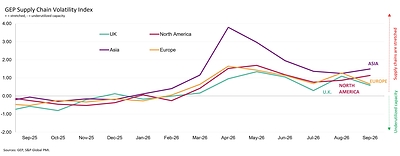
Global input demand growth rose to its strongest since May and was close to its 2026 high, signaling firmer manufacturing activity heading into the fourth quarter. Purchasing strengthened across North America, Asia and Europe, with particularly strong increases in the United States, Germany, Taiwan and South Korea.
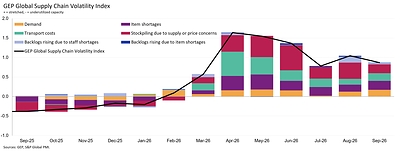
At the same time, supply pressures intensified. Shortages increased for the first time since May, while global transportation costs also rose. Shortages of oil and oil-based products were particularly acute, creating renewed cost and availability pressures for manufacturers.
"Manufacturers are buying more because demand is strengthening, but they're doing so at a time when shortages and transportation costs are starting to rise again," said John Piatek, vice president, GEP Consulting. "For companies, that means the priority shifts from simply protecting inventory to securing supply and controlling costs. If demand continues to build through the fourth quarter, businesses that wait will face tighter availability and higher input costs."
Interpreting the data:
Index > 0, supply chain capacity is being stretched. The further above 0, the more stretched supply chains are.
Index < 0, supply chain capacity is being underutilized. The further below 0, the more underutilized supply chains are.
SEPTEMBER 2026 REGIONAL KEY FINDINGS
SEPTEMBER 2026 KEY FINDINGS
For more information, visit www.gep.com/volatility.
Note: Full historical data dating back to January 2005 is available for subscription. Please contact economics@spglobal.com.
The next release of the GEP Global Supply Chain Volatility Index will be 8 a.m. ET, Nov. 11, 2026.
About the GEP Global Supply Chain Volatility Index
The GEP Global Supply Chain Volatility Index is produced by S&P Global and GEP. It is derived from S&P Global's PMI® surveys, sent to companies in over 40 countries, totaling around 27,000 companies. The headline figure is a weighted sum of six sub-indices derived from PMI data, PMI Comments Trackers and PMI Commodity Price & Supply Indicators compiled by S&P Global.
A Supply Chain Volatility Index is also published at a regional level for Europe, Asia, North America and the U.K. For more information about the methodology, click here.
Media Contacts
Derek Creevey
Director, Public Relations
GEP
Phone: +1 646-276-4579
Email: derek.creevey@gep.com
Joe Hayes
Senior Principal Economist
S&P Global Market Intelligence
Phone: +44-1344-328-099
Email: joe.hayes@spglobal.com
 View original content to download multimedia:https://www.prnewswire.co.uk/news-releases/manufacturers-ramp-up-purchasing-in-september-as-global-demand-strengthens-gep-global-supply-chain-volatility-index-302905220.html

Roche versucht nach einer Phase von Forschungsrückschlägen und Belastungen durch auslaufende Patente, das Tempo in der Medikamentenentwicklung deutlich zu erhöhen. Am Pharma-Investorentag unterstrich die Pharmasparte des Basler Konzerns den Anspruch, in Forschung und Entwicklung weiter zur Spitzengruppe zu gehören. Zentral sind dabei ein strengeres Management der Pipeline, Effizienzprogramme und der verstärkte Einsatz künstlicher Intelligenz entlang der Wertschöpfungskette.
Pharma-Chefin Teresa Graham verwies auf eine sichtbar verbesserte Bilanz seit dem letzten „Pharma Day“: In zehn zulassungsrelevanten Studien habe Roche die gesetzten Ziele erreicht, sechs Programme seien in die zulassungsrelevende Phase vorgerückt, drei weitere in Phase II. Insgesamt verfügt Roche nach eigenen Angaben über bis zu 20 neue Wirkstoffe, die bis 2030 auf den Markt kommen könnten. Einzelne Kandidaten wie das Brustkrebsmittel Giredestrant traut der Konzern dabei jeweils Spitzenumsätze im zweistelligen Milliardenbereich zu.
Um diese Ambitionen abzusichern, verschärft Roche die internen Selektionskriterien. Ende 2023 führte der Konzern mit „The Bar“ einen neuen Bewertungsrahmen für die Pipeline ein. Nur Wirkstoffkandidaten, die klar definierte Anforderungen erfüllen, werden weiterentwickelt. Medizinchef Levi Garraway bezeichnete „The Bar“ als Leitbild für Forschung und Entwicklung. Die Auswahl potenzieller Projekte sei damit spürbar strenger geworden – mit dem Ziel, Ressourcen konsequent auf die Erfolg versprechendsten Programme zu konzentrieren und die Erfolgsquote in späten Studienphasen zu stabilisieren oder weiter zu erhöhen.
Parallel dazu treibt Roche ein Effizienzprogramm voran, um Mittel aus weniger renditestarken in wachstumsstärkere Projekte umzuschichten. Die Entwicklung neuer Medikamente soll deutlich beschleunigt werden, was insbesondere in umkämpften Indikationen wie Onkologie sowie in wachstumsstarken Bereichen wie Herz-Kreislauf- und Stoffwechselerkrankungen an Bedeutung gewinnt. Damit will Roche erwartete Umsatzeinbussen durch Patentabläufe mehr als kompensieren und sich bis zum Ende des Jahrzehnts ein Portfolio aufbauen, das von mehreren potenziellen Blockbustern getragen wird.