CLARK, N.J., June 10, 2026 /PRNewswire/ -- GEP Global Supply Chain Volatility Index, based on a monthly survey of 27,000 businesses, signaled continued pressure on global supply chains in May as manufacturers increased purchases and built safety stocks to protect against rising inflation.

Reports of safety stockpiling rose to their highest level since January 2023, as companies bulk ordered goods and raw materials ahead of expected price increases and potential supply disruption. This front-loaded purchasing pushed global demand for inputs to its strongest since March 2022.
Shortages also worsened in May, reaching their highest level in three-and-a-half years. Combined with elevated transportation costs, the data shows that supply chain pressures are no longer limited to shipping and energy markets.
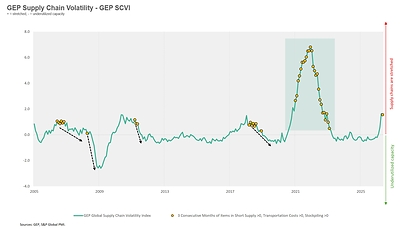
May's data also points to a rare pattern: for three consecutive months, stockpiling, shortages and transportation costs have all been elevated. Outside the 2021-23 supply chain crisis, this has typically been followed by a sharp fall in the index as supply chains self-correct (see chart below), often through weaker input demand or deteriorating economic conditions.
"The path for inflation is already being set, and companies are trying to limit the damage," said John Piatek, vice president, consulting, GEP. "The surge in purchasing we saw in April and May is likely temporary. Once companies have built inventory, they and their customers will pull back, which means supply chain pressures may ease. But, even if the Strait of Hormuz is opened fully, economic conditions will likely weaken in the second half of the year as companies will pull back on their input purchasing to draw down the inventories they've built up."
Interpreting the data:
Index > 0, supply chain capacity is being stretched. The further above 0, the more stretched supply chains are.
Index < 0, supply chain capacity is being underutilized. The further below 0, the more underutilized supply chains are.
MAY 2026 REGIONAL KEY FINDINGS
MAY 2026 KEY FINDINGS
For more information, visit www.gep.com/volatility.
Note: Full historical data dating back to January 2005 is available for subscription. Please contact economics@spglobal.com.
The next release of the GEP Global Supply Chain Volatility Index will be 8 a.m. ET, JuL. 13, 2026.
About the GEP Global Supply Chain Volatility Index
The GEP Global Supply Chain Volatility Index is produced by S&P Global and GEP. It is derived from S&P Global's PMI® surveys, sent to companies in over 40 countries, totaling around 27,000 companies. The headline figure is a weighted sum of six sub-indices derived from PMI data, PMI Comments Trackers and PMI Commodity Price & Supply Indicators compiled by S&P Global.
A Supply Chain Volatility Index is also published at a regional level for Europe, Asia, North America and the U.K. For more information about the methodology, click here.
Media Contacts
Derek Creevey | Joe Hayes | S&P Global Market Intelligence | |
Director, Public Relations | Principal Economist | Corporate Communications | |
GEP | S&P Global Market Intelligence | Email: Press.mi@spglobal.com | |
Phone: +1 646-276-4579 | Phone: +44-1344-328-099 | ||
Email: derek.creevey@gep.com | Email: joe.hayes@spglobal.com |

 View original content to download multimedia:https://www.prnewswire.co.uk/news-releases/safety-stockpiling-hits-highest-level-in-over-three-years-as-businesses-rush-to-protect-against-inflation-and-shortages-gep-global-supply-chain-volatility-index-302794584.html

Das GZO Spital Wetzikon erhält für seine Sanierungsbemühungen mehr Zeit: Das zuständige Nachlassgericht hat die definitive Nachlassstundung letztmals um sechs Monate bis zum 19. Dezember 2026 verlängert. Damit reagiert das Gericht auf ein Übernahmeangebot, das dem Spital Ende März zugegangen ist und derzeit vertieft geprüft wird. Die Sachwalter hatten die Fristverlängerung beantragt, um die laufenden Verhandlungen mit einer nicht namentlich genannten Interessentin fortführen zu können.
Das Kaufangebot ist an mehrere Bedingungen geknüpft. Zentral ist laut Mitteilungen von Spital und Sachwaltern die gesicherte Übertragung beziehungsweise Neuerteilung der kantonalen Leistungsaufträge an eine neue Betreiberin. Erst wenn diese und weitere Bedingungen erfüllt sind, kann ein Verkauf zustande kommen. In diesem Fall rechnen die Sachwalter damit, den Gläubigern einen angepassten Nachlassvertrag mit potenziell besseren Konditionen vorlegen zu können. Die ursprünglich für Mitte Mai geplante Gläubigerversammlung war deshalb bereits im April verschoben worden.
Nach Angaben des Sachwalters sind die Voraussetzungen für die definitive Nachlassstundung weiterhin gegeben. Der laufende Spitalbetrieb gilt als stabil, die während der Nachlassstundung neu eingegangenen Verbindlichkeiten kann das GZO den Angaben zufolge aus dem operativen Geschäft bedienen. Bis zum Ende der nun verlängerten Frist soll der Betrieb in Wetzikon regulär weitergeführt werden. GZO und Sachwalter stehen nach eigenen Aussagen in engem Kontakt mit der Interessentin und wollen über das weitere Verfahren und einen neuen Termin für die Gläubigerversammlung informieren, sobald der Stand der Verhandlungen dies zulässt.
Das Spital Wetzikon befindet sich seit bald zwei Jahren in einer existenziellen finanziellen Krise. Auslöser ist vor allem eine Anleihe über 170 Millionen Franken, die im Juni 2024 hätte zurückgezahlt werden müssen. Da die Mittel dafür fehlten, wurde das Nachlassverfahren eingeleitet. Mit der nun gewährten letzten Verlängerung der Nachlassstundung bleibt dem GZO ein begrenztes Zeitfenster, um den Verkauf abzuschliessen und eine für Gläubiger tragfähige Lösung zu finden. Eine weitere Erstreckung der Frist ist rechtlich nicht vorgesehen.