HANGZHOU, China, Sept. 4, 2026 /PRNewswire/ -- SCANOLOGY, a global provider of 3D scanning and inspection solutions, has introduced TrackScan Sharp-Z and TrackScan GO, two optical 3D scanning systems designed to make industrial inspection more mobile, accessible, and adaptable to different working environments.
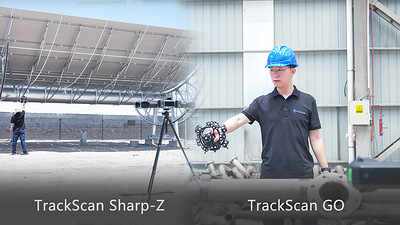
The new systems enable manufacturers to deploy 3D measurement more efficiently on the site, whether inspecting oversized structures or moving between production areas and confined spaces. Together, the systems reflect SCANOLOGY's focus on combining measurement capabilities with simpler deployment and operation.
For large-scale applications, TrackScan Sharp-Z offers a tracking distance of up to 12 meters. Its Fully Self Tracking technology automatically rotates the tracker to follow the 3D scanner, reducing the need for repeated repositioning when inspecting large components such as aircraft structures, commercial vehicles, and energy equipment.
TrackScan GO addresses portability and versatility. The complete system fits into a single carrying case, while its tracker and scanner can operate together or independently. Three measurement configurations support marker-free optical tracking, wide-area scanning, and handheld inspection in confined spaces.
The measurement performance of both systems is evaluated in accordance with ISO 10360-13.
For teams handling varied inspection tasks, this flexibility can reduce the need to transport separate devices and make it easier to adapt the setup to the workpiece.
Both systems use SCANOLOGY's smart wireless architecture, with edge computing processing camera images before transmitting measurement data. This reduces data transmission requirements and supports cable-free scanning.
Ease of use is another shared priority. TrackScan Sharp-Z combines automatic tracking with dual-screen interaction. A color camera and AR overlay on TrackScan GO help users relate measurement data to the physical workpiece and document visible surface defects on the 3D model.
Both systems operate on SCANOLOGY's unified industrial measurement software platform, supporting a consistent workflow from scanning through analysis and reporting.
Preconfigured routines can also help teams repeat established inspection procedures, reducing manual setup and supporting more consistent reporting across operators working on similar tasks.
By addressing both large-scale coverage and portable deployment, SCANOLOGY aims to help manufacturers extend 3D inspection into more production and field environments while making advanced measurement tools easier to use.
For more information, visit SCANOLOGY's website.
 View original content to download multimedia:https://www.prnewswire.co.uk/news-releases/scanology-sets-new-benchmarks-in-large-scale-and-portable-3d-measurement-with-trackscan-sharp-z-and-trackscan-go-302870040.html

Inflationssorgen und steigende Ölpreise haben Europas wichtigste Aktienmärkte zur Wochenmitte spürbar belastet und zugleich die Monatsbilanz eingetrübt. Der EuroStoxx 50 schloss am Mittwoch 0,81 Prozent tiefer bei 6269,02 Punkten. Im Monatsverlauf verlor der Leitindex der Eurozone 2,4 Prozent und beendete damit eine Serie von fünf Anstiegen in Folge. Der DAX gab um 0,79 Prozent auf 25.199,19 Punkte nach, während der britische FTSE moderat um rund ein Viertel Prozent auf gut 10.600 Zähler nachgab.
Treiber der Risikoaversion waren neue Inflationsdaten aus großen Euroländern. In Deutschland kletterten die Verbraucherpreise im September auf 3,3 Prozent gegenüber dem Vorjahr und damit erstmals seit Ende 2023 wieder über die Marke von drei Prozent, nachdem im August noch 2,9 Prozent verzeichnet worden waren. Starke Anstiege der Energiepreise wirkten als Hauptfaktor – eine Entwicklung, die sich nach ersten Angaben auch in Frankreich und Italien widerspiegelt. In Italien kam es zudem zu einem deutlichen Anstieg der Teuerung, was die Sorge nährte, dass der disinflationäre Trend im Euroraum ins Stocken geraten könnte.
Parallel dazu zogen die Ölpreise erneut an. Marktteilnehmer verwiesen auf die angespannte geopolitische Lage im Nahen Osten und mögliche Risiken für die Öllieferungen aus dem Persischen Golf. Berichte, wonach mehrere Tankschiffe in der Straße von Hormuz unter Beschuss geraten sein sollen, verstärkten die Nervosität. Höhere Energiekosten und im Umfeld der Inflationsdaten steigende Anleiherenditen machten Anleger nach Einschätzung von Marktstrategen europaweit selektiver. Ulrich Urbahn, Leiter Multi-Asset-Strategie und Research bei Berenberg, sieht dennoch Chancen für eine Jahresendrallye: Robuste Unternehmensgewinne könnten die Märkte stützen, sofern Firmen ihre Margen und Prognosen behaupten und sowohl Inflation als auch Renditen nicht weiter zulegen.
Im Branchenspektrum fehlten klare Impulse von den Technologiewerten, die nach Vortagesgewinnen überwiegend richtungslos tendierten. Viele Investoren warteten auf die anstehenden Quartalszahlen des US-Speicherchip-Herstellers Micron, die als Gradmesser gelten, ob der Boom rund um Künstliche Intelligenz weiterhin ausreichend im operativen Geschäft der Halbleiterbranche ankommt. Analyst Andreas Lipkow von CMC Markets warnte, eine Enttäuschung bei Micron könne die zuletzt gewachsene Skepsis gegenüber dem KI-Sektor rasch in neuen Verkaufsdruck umschlagen lassen. Einzelwerte wie BMW im DAX konnten sich diesem Umfeld zwar mit Kursgewinnen entziehen, insgesamt dominierte an den europäischen Börsen jedoch zum Monatsende die Vorsicht.