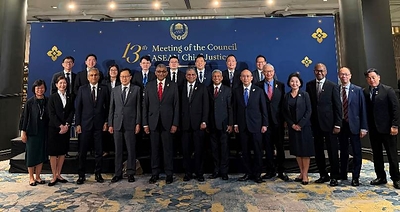
SINGAPORE, Aug. 31, 2026 /PRNewswire/ -- The Singapore Judiciary, led by The Honourable the Chief Justice Sundaresh Menon, participated in the 15th ASEAN Law Association (ALA) General Assembly, 47th ALA Governing Council Meeting and 13th Council of ASEAN Chief Justices (CACJ) Meeting from 21 to 23 July 2026 in Bangkok, Thailand.
At the 47th ALA Governing Council Meeting, Justice Lee Seiu Kin presented the findings of the Crossroads 2.0 Working Group, which identified priority areas for harmonisation in commercial and trade laws, cross-border insolvency, alternative dispute resolution, specialist practice and emerging areas such as the digital economy, artificial intelligence and climate. Justice S Mohan gave an update on the Virtual Training Marketplace, a web portal that matches young lawyers with cross-border training and attachment opportunities across ASEAN member countries. It now has 24 participating firms and facilitated its first successful placement in the past year.
At the 13th CACJ Meeting, all 11 ASEAN jurisdictions discussed initiatives spanning judicial education, cross-border cooperation, technology and emerging legal issues. Key developments included the publication of the first volume of the Memorandum of Guidance on Enforcement of Money Judgments within ASEAN and a Simplified Protocol on Verification Procedure to Authenticate Court Orders within ASEAN, as well as the adoption of a Roadmap to promote the use of Therapeutic Justice and Therapeutic Justice-related practices in ASEAN. The CACJ also continued its work to revise the Governance Framework on the Use of AI for ASEAN Judiciaries. At the close of the Meeting, the CACJ recorded its deep appreciation to Chief Justice Menon for his longstanding contributions to the CACJ.
Singapore judges also contributed to several meetings held on the sidelines of the ALA and CACJ sessions. At the 4th Standing Meeting of ASEAN Insolvency Judges, participants discussed the implementation of the Model Framework for Communication and Cooperation between ASEAN Courts in Cross-Border Insolvency Proceedings and agreed on a scenario-based pilot project on judicial assistance in foreign insolvency proceedings. At the ASEAN Law Conference, Justice Aidan Xu spoke at a session on judicial responses to the use of generative AI in court submissions. ASEAN insolvency and intellectual property judges also met practitioners to exchange views on cross-border restructuring and the enforcement of intellectual property rights.
The meetings underscored the Singapore Judiciary's continued role in advancing ASEAN's efforts to deepen judicial cooperation, strengthen cross-border frameworks and develop future-ready justice systems.
 View original content to download multimedia:https://www.prnewswire.co.uk/news-releases/singapore-judiciary-strengthens-judicial-and-legal-cooperation-within-asean-in-bangkok-meetings-302864793.html

Beim Winterthurer Textilmaschinenhersteller Rieter kommt es zu einem abrupten Führungswechsel. CEO und Verwaltungsratspräsident Thomas Oetterli gibt beide Ämter per Ende Oktober ab. An die Spitze der Geschäftsführung rückt Anfang November der Branchenkenner Daniel Lippuner, während Carl Illi mit sofortiger Wirkung das Präsidium des Verwaltungsrats übernimmt. Rieter begründet den Schritt damit, dass nach der Umsetzung zentraler strategischer Projekte nun der Zeitpunkt gekommen sei, die Verantwortung in neue Hände zu legen.
Lippuner gilt als ausgewiesener Experte für Spinnmaschinen, Garnverarbeitung und Textilkomponenten. Er leitete früher den Textilmaschinenhersteller Saurer und zuvor den Bereich Oerlikon Textile Components. Zudem ist er Verwaltungsratspräsident und Miteigentümer von Heberlein Technology und damit weiterhin eng in der Chemiefaserindustrie verankert. Illi gehört dem Rieter-Verwaltungsrat seit 2017 an und wird vom Unternehmen ebenfalls als Textilexperte charakterisiert. Er soll das Präsidium mindestens bis zur nächsten Generalversammlung führen.
Oetterli, Jahrgang 1969 und früher Chef des Lift- und Rolltreppenherstellers Schindler, war im März 2023 zu Rieter geholt worden, um den bereits damals kriselnden Maschinenbauer zu stabilisieren. Noch im selben Jahr lancierte er das Performance-Programm «Next Level», das ein massives Kostensenkungs- und Restrukturierungspaket umfasst. Der Plan sah unter anderem vor, bis 2025 rund 1400 Vollzeitstellen vorwiegend in Deutschland, der Schweiz und weiteren europäischen Ländern abzubauen und Standorte zu konsolidieren. Parallel dazu übernahm Rieter im Februar die Textilmaschinensparte Barmag von OC Oerlikon, was mit einem deutlichen Anstieg der Verschuldung einherging.
Trotz dieser einschneidenden Massnahmen blieb die erhoffte Trendwende aus. Die Amtszeit Oetterlis war von einem ausserordentlich schwachen Marktumfeld mit anhaltender Nachfrageschwäche geprägt. 2024 hatte er zusätzlich das Präsidium des Verwaltungsrats übernommen – ein Doppelmandat, das den Aktionären ursprünglich als Übergangslösung zur konsequenten Umsetzung von «Next Level» verkauft worden war. Grösster Anteilseigner bei Rieter ist der Schweizer Industrielle Peter Spuhler mit einem Anteil von 33,1 Prozent; er sitzt ebenfalls im Verwaltungsrat. Der Führungswechsel in Winterthur folgt zeitlich auf eine ebenfalls angekündigte Neubesetzung an der Spitze von Stadler Rail, einem weiteren Unternehmen, an dem Spuhler die Kontrolle hält.