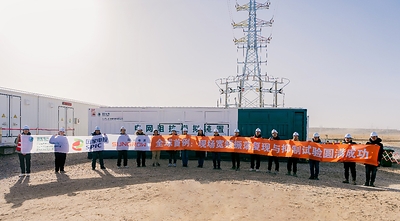
HEFEI, China, Sept. 17, 2026 /PRNewswire/ -- Sungrow, a globally leading PV inverter and energy storage system provider, recently has achieved a world first by controllably reproducing and successfully suppressing wideband oscillation at a real-world 500 MW solar-plus-storage plant in Qinghai, China. The field test marks a major step toward addressing one of the long-standing challenges facing renewable power systems as renewable penetration continues to increase worldwide.
As renewable penetration rises worldwide, wideband oscillation has become a major challenge, with severe cases potentially causing renewable plants to disconnect from the grid or shut down. In 2014, the BorWin1 offshore HVDC project in Germany experienced oscillations at 250–350 Hz, which damaged filter capacitors on the offshore converter platform and led to a shutdown lasting approximately six months, causing substantial economic losses to the local utility. In 2019, the Hornsea offshore wind farm in the UK experienced widespread disconnection due to subsynchronous oscillation, resulting in a loss of approximately 3.2% of the system load and affecting around one million users. Past incidents have demonstrated the significant impact of oscillation-related events.
However, the complex and unpredictable nature of the phenomenon has made it difficult to safely and controllably reproduce oscillations at real-world plants and validate effective suppression methods in the field. As a result, research has largely remained at the theoretical and simulation stage, with limited systematic validation in actual power plant environments.
To bridge this gap, Sungrow and its industry partners conducted a field test at the plant, using Sungrow PV inverters deployed across the site.
Controlled Reproduction of Wideband Oscillation
The test established weak-grid conditions and identified three key contributing factors—power output, system short-circuit ratio (SCR), and control parameters—before successfully achieving controlled reproduction of a localized system oscillation.
Rapid Suppression of Wideband Oscillation
The field test evaluated the oscillation suppression performance of Sungrow's PV inverters under different grid conditions. Leveraging Sungrow's patented grid-strength adaptation technology, the inverters identified grid strength within 40 milliseconds, adjusted their control strategies accordingly, and rapidly stabilized voltage and frequency.
The test also validated the effectiveness of grid-forming control in suppressing wideband oscillation. Sungrow's grid-forming control strategy enables stable operation across a wide SCR range of 1~40 and effectively mitigates transient overvoltage.
By successfully reproducing and suppressing wideband oscillation at a real-world 500MW plant, the field test marks a critical step in moving wideband oscillation suppression from the laboratory into engineering practice, with the potential to improve the stability of renewable energy plants under extremely weak grid conditions, prevent grid disconnections caused by oscillations, unlock greater power export capacity for plants connected to weak grids, and reduce generation losses.
"For renewable energy to become a truly stable and reliable source of power, it is essential to develop autonomous fault self-healing and grid-support capabilities." Pan Nian'an, Chief Engineer and Chief Expert for Utility PV BU at Sungrow, said Sungrow will continue to advance research and development in grid technologies, focusing on key innovations including wideband oscillation suppression, grid-forming control, and multi-energy coordination. These efforts aim to support the stable grid integration and efficient utilization of renewable energy while strengthening the technical foundation for a secure and stable energy transition and next-generation power systems.

 View original content to download multimedia:https://www.prnewswire.co.uk/news-releases/sungrow-achieves-world-first-wideband-oscillation-reproduction-and-suppression-at-500-mw-plant-302881815.html

Sandro Brotz kehrt dem Schweizer Radio und Fernsehen den Rücken und wechselt Anfang 2027 zur Boulevardzeitung «Blick». Der 56-jährige Journalist, derzeit Moderator und stellvertretender Leiter der Polit-Talksendung «Arena», wird SRF Ende Januar 2027 verlassen. Bis voraussichtlich Mitte Januar führt er weiterhin durch die «Arena». Beim zum Ringier-Konzern gehörenden «Blick» soll Brotz einen neuen Video-Podcast aufbauen und moderieren, der mehrmals pro Woche Themen aus Politik, Wirtschaft und Gesellschaft aufgreift.
Der Schritt markiert das Ende einer knapp 15-jährigen SRF-Ära für Brotz. Seit seinem Wechsel nach Leutschenbach im Juni 2012 prägte er zunächst als Moderator der investigativen Sendung «Rundschau» das Programm, später zusätzlich als Gastgeber des «Rundschau Talk». 2019 übernahm er schliesslich die «Arena» von Jonas Projer. Als Grund für den Wechsel nennt Brotz die Möglichkeit, bei «Blick» ein neues Format mitzuentwickeln und damit über die Rolle des klassischen Moderators hinauszugehen. Ganz neu ist das Ringier-Umfeld für ihn nicht: Vor seiner SRF-Zeit war er bereits unter anderem stellvertretender Chefredaktor des «SonntagsBlick».
Der Abgang von Brotz wirft bei SRF unmittelbar die Nachfolgefrage auf. Als Topfavorit galt zuletzt sein Kollege Mario Grossniklaus, der seit 2024 einmal im Monat die «Arena» moderiert und damit Brotz entlastet. Der 49-Jährige hat dieser Spekulation nun jedoch eine klare Absage erteilt. Auf Linkedin schrieb Grossniklaus, er werde sich nicht auf die Nachfolge seines «geschätzten Kollegen» bewerben. Stattdessen wolle er sich auf seine Aufgaben in der Wahlleitung von SRG und SRF konzentrieren – eine Funktion, die er als «grösste und spannendste Aufgabe» seiner bisherigen Karriere bezeichnet.
Mit der Absage von Grossniklaus bleibt offen, wer Brotz ab etwa Mitte Januar beerben wird. SRF verweist darauf, man wolle sich vorerst auf eine geordnete Übergabe der «Arena» konzentrieren. Der Wechsel von Brotz reiht sich ein in eine Serie prominenter Abgänge von SRF in Richtung Dufourstrasse: Bereits zuvor hatten unter anderem Reto Scherrer, Steffi Buchli, Christine Maier, Hannes Britschgi und der frühere «Arena»-Moderator Jonas Projer den Schritt zum Ringier-Konzern gewagt. Die Motive reichen von besseren Angeboten bis hin zum Wunsch, den eigenen Namen in neuen Rollen und Formaten zu positionieren – mit sehr unterschiedlichem Ausgang.