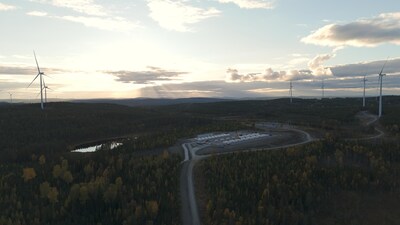
STOCKHOLM, July 27, 2026 /PRNewswire/ -- The largest battery energy storage system (BESS) project in the Nordics in Ånge, Sweden has now been taken into commercial operation. Sungrow, a global leader in battery storage and PV inverters, delivered its utility BESS PowerTitan 2.0 for the 70 MW / 160 MWh battery system developed by Delta Capacity. Designed to deliver high reliability and efficiency, the system is built to operate under challenging Nordic weather conditions and extreme temperature variations.
The Ånge BESS will contribute to balancing Sweden's power system, offering rapid response capabilities and capacity for both frequency regulation and arbitrage across the volatile Nordic power market. Sweden's battery storage market is expanding rapidly as the country's energy transition accelerates. The regulatory framework has enabled battery storage to participate in balancing markets, turning it into a revenue-generating asset, according to a report from SolarPower Europe. Sweden and Finland together installed more than 1 GWh of new battery capacity in 2025[1].
"Ånge is a great example of how large-scale energy storage is built in practice. Fast, at the right scale, and with the right partners like Delta Capacity. Our role is to be a long-term partner and contribute to expanding renewable energy capacity in Sweden," says Samer Nameer, Country Manager Sweden at Sungrow.
Fast deployment for the Nordic energy transition
The Ånge project is owned by a joint venture between WOOD & Company Renewables Sub-Fund and Delta Capacity, which has led the project from design to completion. From procurement start to commercial operation took 15 months. The facility is located in bidding zone SE2 and contributes to balancing the Swedish power system.
Patrik Hes, CEO of Delta Capacity: "The Nordic energy transition is moving fast and requires infrastructure that keeps the same pace. Sweden has great renewable resources, but flexibility is missing and that is exactly what Ånge provides. 160 MWh of storage, delivered in 15 months. Delta Capacity's goal is to keep building faster and at a greater scale. The energy transition cannot wait."
The project was acquired from RES in February 2025. Other suppliers in the project are Stenger & Ibsen Construction, Rejlers, Green Power Monitor, Solvina and Ellevio. Centrica Energy manages the buying and selling of electricity for the facility around the clock.
Local presence with a global footprint
Sungrow Europe currently has 25 local offices, two research and development centres and 26 warehouses across Europe. The Swedish team with dedicated experts for Services, and energy solutions is based in Stockholm, with other Scandinavian offices in Malmö, Copenhagen and Helsinki. Among its most recent projects in the Nordic region are the Nordic region's largest solar roof in Sweden[2] (14 MW) and the northernmost solar project in Finland[3] (70 MW)."
About Sungrow
Sungrow, a global leader in renewable energy technology, has pioneered sustainable power solutions for over 29 years. As of Dec 2025, Sungrow has installed over 1000 GW of power electronic converters worldwide. The company is recognized as the world's most bankable PV inverter and energy storage company (BloombergNEF). Its innovations power clean energy projects across the globe, supported by a network of 520 service outlets guaranteeing excellent customer experiences. At Sungrow, we're committed to bridging to a sustainable future through cutting-edge technology and unparalleled service. For more information, please visit: www.sungrowpower.com/en
About Delta Capacity
Founded in 2022, Swiss-based Delta Capacity is driven by its vision to develop, acquire, and own and operate utility-scale battery storage across Europe. The company is scaling quickly while maintaining a consistent focus on asset quality—prioritizing designs that support high availability, efficient performance, and bankable operating outcomes. The rapidly growing team brings decades of experience across large infrastructure, renewable energy, energy trading, and software development. Delta Capacity currently has nearly 800 MWh under construction and targets the build-out, commissioning, and operation of more than 6 GWh of flexible assets by 2030.

Photo - https://mma.prnewswire.com/media/3007864/Sungrow_Delta_AngeBESS.jpg
Logo - https://mma.prnewswire.com/media/1344575/Logo.jpg
 View original content:https://www.prnewswire.co.uk/news-releases/sungrow-powers-the-nordics-largest-commissioned-bess-project-in-sweden-with-powertitan-2-302835061.html

Postauto treibt den Einsatz autonomer Fahrzeuge in der Ostschweiz voran und bereitet nach eigenen Angaben Europas grösstes Robo-Taxi-Netz vor. Das Bundesamt für Strassen (Astra) hat dem Unternehmen eine Ausnahmebewilligung erteilt, damit die speziell ausgerüsteten E-Autos im St. Galler Rheintal sowie in den Kantonen Appenzell Ausserrhoden und Appenzell Innerrhoden automatisch verkehren dürfen. Seit dem 1. Juni sind die Fahrzeuge in einem rund 80 Quadratkilometer grossen Gebiet unterwegs – vorerst noch zu Testzwecken und mit Sicherheitsfahrerinnen und -fahrern an Bord.
Herzstück des Projekts ist die Flotte von bis zu 25 sogenannten "AmiGo"-Fahrzeugen, die im Endausbau mit Automatisierungsgrad Level 4 fahren sollen. Postauto kooperiert dafür mit Apollo Go, der Robotaxi-Sparte des chinesischen Technologiekonzerns Baidu. Die Fahrzeuge werden im typischen Postauto-Gelb lackiert und elektrisch betrieben. Während der Testphase dürfen die Sicherheitsfahrer ihre Hände vom Lenkrad nehmen; sie können jedoch jederzeit eingreifen, wenn die Situation es erfordert – etwa an unübersichtlichen Verzweigungen oder bei forsch auftretendem Gegenverkehr.
Im Alltagstest auf einer festgelegten Route in Altstätten (SG) zeigt sich das System laut Projektbeteiligten bereits weitgehend stabil, auch wenn der Fahrkomfort in Kurven noch nicht an einen menschlichen Chauffeur heranreicht. Auffällig ist das sehr defensive Verhalten, etwa vor Fussgängerstreifen, wo das Fahrzeug früh abbremst, selbst wenn sich Personen noch in einiger Entfernung befinden. Gesteuert wird der Betrieb zusätzlich aus einer Leitstelle, in der Operatorinnen und Operatoren die Fahrten überwachen und bei Bedarf aus der Ferne eingreifen können.
Der reguläre Betrieb mit fahrerlosen Fahrzeugen ist ab 2027 vorgesehen. Postauto plant, dass Fahrgäste in der Region ihre autonome Fahrt dann probeweise per App buchen können. Astra-Direktor Jürg Röthlisberger sieht im automatisierten Fahren eine grosse Chance und spricht dem Projekt das Potenzial eines "Gamechangers" zu. Es ist nicht der erste Versuch mit selbstfahrenden Fahrzeugen in der Schweiz, aber nach Umfang und Einsatzgebiet der bislang weitreichendste. Die Technologie soll schrittweise verfeinert und insbesondere für ländliche Regionen erprobt werden, in denen flexible, bedarfsgesteuerte Angebote die bestehende Grunderschliessung ergänzen könnten.