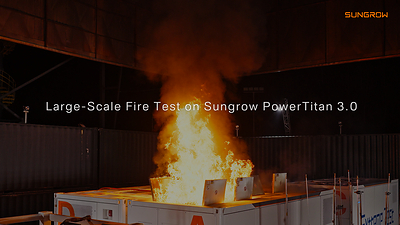
HEFEI, China, Oct. 21, 2026 /PRNewswire/ -- Sungrow, a globally leading PV inverter and energy storage system provider, announced that its latest PowerTitan 3.0 battery energy storage system (BESS) has successfully completed a large-scale fire test conducted in accordance with the latest applicable requirements of UL 9540A: 2026 and CSA/ANSI C800-2025, making it the industry's first stacked-cell BESS with an AC-block design to successfully complete such a test. From PowerTitan 1.0 to 3.0, all three generations passed the large-scale fire test on the first attempt.
Conducted by UL Solutions, witnessed by Fire Risk Alliance (FRA), and observed by Jensen Hughes (JH), the test evaluated the system's ability to contain a severe thermal runaway event and prevent it from propagating to adjacent BESS containers and the Medium-Voltage Substation.
Tested Under Demanding Real-World Installation Conditions
The test setup replicated the block-level layout of a real-world utility-scale BESS installation, including 28.56 MWh of fully liquid-cooled PowerTitan 3.0 BESS and a 7.4 MW Medium-Voltage Substation (MVS). PowerTitan 3.0 features high-energy-density stacked cells and an integrated AC block architecture, combining the battery system and DC/AC Power Converter Unit within a single 20-foot container.
To further challenge the system's safety design, the BESS was at 100% state of charge. The initiating container and the adjacent container were installed back-to-back closely. The MVS was also included in the test configuration. All active fire suppression systems and thermal management system were disabled, and rooftop pressure-relief panels of the initiating container were also fully opened to maximize ventilation and oxygen availability. The test focused on the system's inherent ability to contain thermal runaway.
All smoke and fire effluent generated during the event were collected and routed through a dedicated purification system. The collected gases were fully treated, with no untreated smoke released directly into the environment.
Thermal Runaway Did Not Propagate
The test successfully demonstrated that thermal runaway did not propagate from the initiating BESS container to any adjacent containers or the MVS.
The test continued for 7.5 hours under uninterrupted monitoring. The peak internal temperature in the initiating container, identified as Container A, reached 1259.8°C, while the highest cell temperature in the adjacent containers well remained below the threshold for thermal runaway under UL 9540A: 2026.
Despite the intensity and duration of the fire, Container A remained structurally intact. Adjacent Containers B, C, D and E also remained structurally intact, with no deformation. Even after the fire test, the container remained structurally intact and could be lifted as a complete unit.
Under full-charge, close-spacing and maximum-ventilation conditions, the PowerTitan 3.0 contained the thermal event within the initiating container and prevented it from escalating into a multi-container event. The results demonstrate stable, reliable and controllable system performance under extreme conditions and mark a key step in validating the safety of higher-energy BESS platforms.
Three Generations. All Successfully Tested. Simulation Meets Reality.
From PowerTitan 1.0 and 2.0 to PowerTitan 3.0, all three generations have completed their large-scale fire tests on the first attempt, enabling Sungrow to build a comprehensive database of thermal runaway and fire behavior. Before the physical test, PowerTitan 3.0 underwent simulation-based assessments across hundreds of application scenarios and operating conditions using Sungrow's simulation platform, the world's largest of its kind. The simulated fire intensity and development trends closely matched those observed during the physical test, validating the model's ability to predict fire behavior under extreme conditions.
"This test was about verifying our safety design under real-world extreme conditions," said Roger Li, General Manager of the Utility-Scale Product Line, Sungrow Energy Storage Business Unit. "Safety must be engineered into the product from the beginning. Simulation helps predict how the system will respond, while large-scale fire testing puts those predictions to the test. Energy storage safety is about far more than cell safety alone. It is the result of multiple factors working together, including cell performance, system integration, thermal management, structural protection, engineering design, and more."
Benjamin Liu, Engineering Manager at UL Solutions, commented: "Sungrow started with safety by design, used pre-test assessments to predict fire behavior, and then validated those predictions through a large-scale fire test. The test result showed that the design was able to contain the fire and prevent propagation, helping significantly reduce the potential scale of loss."
By bringing together safety-by-design engineering, predictive simulation and large-scale physical testing, Sungrow is building a robust, evidence-based approach to BESS safety. For project owners, investors, insurers and emergency responders, this provides a stronger technical basis for assessing fire risks, planning emergency responses and protecting critical assets throughout a project's lifecycle.

 View original content to download multimedia:https://www.prnewswire.co.uk/news-releases/three-generations-all-first-time-passes-powertitan-3-0-validates-system-level-safety-under-extreme-large-scale-fire-test-302915315.html

Beim Winterthurer Textilmaschinenhersteller Rieter kommt es zu einem abrupten Führungswechsel. CEO und Verwaltungsratspräsident Thomas Oetterli gibt beide Ämter per Ende Oktober ab. An die Spitze der Geschäftsführung rückt Anfang November der Branchenkenner Daniel Lippuner, während Carl Illi mit sofortiger Wirkung das Präsidium des Verwaltungsrats übernimmt. Rieter begründet den Schritt damit, dass nach der Umsetzung zentraler strategischer Projekte nun der Zeitpunkt gekommen sei, die Verantwortung in neue Hände zu legen.
Lippuner gilt als ausgewiesener Experte für Spinnmaschinen, Garnverarbeitung und Textilkomponenten. Er leitete früher den Textilmaschinenhersteller Saurer und zuvor den Bereich Oerlikon Textile Components. Zudem ist er Verwaltungsratspräsident und Miteigentümer von Heberlein Technology und damit weiterhin eng in der Chemiefaserindustrie verankert. Illi gehört dem Rieter-Verwaltungsrat seit 2017 an und wird vom Unternehmen ebenfalls als Textilexperte charakterisiert. Er soll das Präsidium mindestens bis zur nächsten Generalversammlung führen.
Oetterli, Jahrgang 1969 und früher Chef des Lift- und Rolltreppenherstellers Schindler, war im März 2023 zu Rieter geholt worden, um den bereits damals kriselnden Maschinenbauer zu stabilisieren. Noch im selben Jahr lancierte er das Performance-Programm «Next Level», das ein massives Kostensenkungs- und Restrukturierungspaket umfasst. Der Plan sah unter anderem vor, bis 2025 rund 1400 Vollzeitstellen vorwiegend in Deutschland, der Schweiz und weiteren europäischen Ländern abzubauen und Standorte zu konsolidieren. Parallel dazu übernahm Rieter im Februar die Textilmaschinensparte Barmag von OC Oerlikon, was mit einem deutlichen Anstieg der Verschuldung einherging.
Trotz dieser einschneidenden Massnahmen blieb die erhoffte Trendwende aus. Die Amtszeit Oetterlis war von einem ausserordentlich schwachen Marktumfeld mit anhaltender Nachfrageschwäche geprägt. 2024 hatte er zusätzlich das Präsidium des Verwaltungsrats übernommen – ein Doppelmandat, das den Aktionären ursprünglich als Übergangslösung zur konsequenten Umsetzung von «Next Level» verkauft worden war. Grösster Anteilseigner bei Rieter ist der Schweizer Industrielle Peter Spuhler mit einem Anteil von 33,1 Prozent; er sitzt ebenfalls im Verwaltungsrat. Der Führungswechsel in Winterthur folgt zeitlich auf eine ebenfalls angekündigte Neubesetzung an der Spitze von Stadler Rail, einem weiteren Unternehmen, an dem Spuhler die Kontrolle hält.