MILFORD, Mass., June 8, 2026 /PRNewswire/ -- 55th International Symposium on High Performance Liquid Phase Separations and Related Techniques—Waters Corporation (NYSE: WAT) today announced the launch of the BioResolve™ Peptide and GTxResolve™ Lipid Phenyl-Hexyl+ and C18+ Columns, a first-of-its-kind reversed-phase (RP) column platform designed to tackle a persistent biopharmaceutical challenge: reliably separating structurally and chemically similar impurities in GLP-1 peptides, insulin, and lipid nanoparticles (LNPs) to support the development of safe, effective drug products.
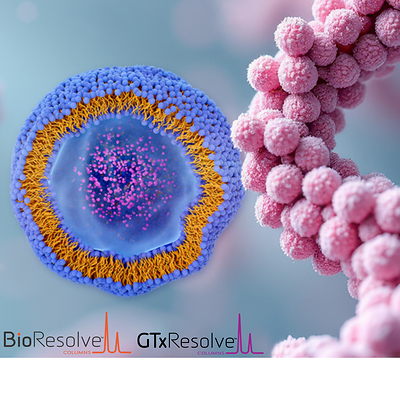

In GLP-1 receptor agonists and newer mRNA-based therapies such as in vivo CAR T, difficulty resolving impurities can delay time to market, weaken regulatory confidence, and affect patient safety. Traditional RP columns do not always separate low-level or closely related impurities well, often requiring longer analyses, detector-suppressing mobile-phase additives, or repeated method redevelopment. BioResolve Peptide and GTxResolve Lipid Columns help to overcome these limitations with ready-to-use methods that improve both resolution1,2 and speed2,3 while fitting into existing workflows.
"We have made simultaneous advances in both chemistry and particle physics to deliver the first columns Waters has introduced to market specifically QC batch-tested for GLP‑1 analysis4 and lipid nanoparticles,2 solving a longstanding customer pain point," said Erin Chambers, Vice President, General Manager, Consumables & Lab Automation, Waters Analytical Sciences, Waters Corporation. "BioResolve Peptide and GTxResolve Lipid Columns are designed to resolve chemically similar GLP‑1 impurities and LNP components faster when speed matters,2,3 and with extraordinary resolution1 when certainty is required. The result is simpler method development, regulatory‑ready data,5 and faster, highly reproducible methods, ultimately helping to reduce cost burdens on important new therapeutics."
BioResolve Peptide and GTxResolve Lipid Columns use specially designed surface chemistries and superficially porous particles to deliver precise RP separations with selectivity for two difficult sample types. Available in Phenyl-Hexyl+ and C18+ chemistries with 230 Å pore size particles, they are designed to support efficient mass transfer, consistent performance across U(H)PLC and HPLC systems, and reliable, batch-tested results5 from early-stage research through manufacturing.
GLP-1 peptides are especially challenging to analyze because many impurities differ by just one atom, while others have no difference in atomic composition and vary only in how their atoms are arranged spatially. BioResolve Peptide Phenyl-Hexyl+ and C18+ Columns are built to resolve these difficult impurities, with specialized 300 mm formats available when maximum separation performance and deeper impurity characterization are required.
"The BioResolve Peptide RP Columns have performed exceptionally well, showing outstanding resolution between our peptide therapeutics and related impurities," said Ashish Kanhed, Group Leader, Alembic Pharmaceuticals. "We are highly impressed with their quality and look forward to continuing to use them for our complex GLP-1 and peptide separations. By discriminating critical impurities at speed with a mass spectrometry-based QC approach, we can now satisfy present and future regulatory requirements in one run for faster, more confident answers on molecular purity."
For LNP and lipid workflows, the charged surface of GTxResolve Columns helps sharpen peaks for ionizable lipids by reducing tailing. Their larger pore size makes it easier for a wide range of lipid molecules to move through the column, improving peak shape and resolving challenging co-elutions. In addition, the superficially porous particle design speeds the movement of molecules through the stationary phase, shortening run times without reducing selectivity.2
"GTxResolve Lipid RP Columns have demonstrated strong performance for lipid quantitation and impurity analysis, with reduced run times and excellent peak shape," said Adam Kowalczyk, Research Scientist II, Analytical Development, Acuitas Therapeutics. "The ability to tune separations for specific lipid components, combined with compatibility across multiple detector platforms (UV, MS, ELSD, and CAD), provides significant flexibility for characterization of diverse lipid species. In particular, we have observed a separation of ionizable lipids that has not previously been achieved."
Waters' BioResolve Peptide and GTxResolve Lipid Columns will be available globally beginning June 9, 2026, starting with the 1.6 µm Phenyl-Hexyl+ phase. For more information, please visit waters.com/BioResolve and waters.com/GTx.
Additional Resources:
Waters, BioResolve, GTxResolve, and Empower are trademarks of Waters Corporation or its affiliates. All other trademarks are the property of their respective owners.
About Waters Corporation:
Waters Corporation (NYSE: WAT) is a global leader in life sciences and diagnostics, dedicated to accelerating the benefits of pioneering science through analytical technologies, informatics, and services. With a focus on regulated, high-volume testing environments, our innovative portfolio harnesses deep scientific expertise across chemistry, physics, and biology. We collaborate with customers around the world to advance the release of effective, high-quality medicines, ensure the safety of food and water, and drive better patient outcomes by detecting diseases earlier, managing routine infections, and combating antibiotic resistance. Through a shared culture of relentless innovation, our passionate team of approximately 16,000 colleagues turn scientific challenges into breakthroughs that improve lives worldwide. For more information, please visit www.waters.com/about.
References:
Contact:
Molly Gluck
Head of External Communications
Waters Corporation
508.498.9732
molly_gluck@waters.com
 View original content to download multimedia:https://www.prnewswire.co.uk/news-releases/waters-launches-industry-first-reversed-phase-bioseparation-columns-to-deliver-up-to-3x-faster-glp-1-characterization-and-2x-faster-lnp-component-analysis-302793693.html

Postauto treibt den Einsatz autonomer Fahrzeuge in der Ostschweiz voran und bereitet nach eigenen Angaben Europas grösstes Robo-Taxi-Netz vor. Das Bundesamt für Strassen (Astra) hat dem Unternehmen eine Ausnahmebewilligung erteilt, damit die speziell ausgerüsteten E-Autos im St. Galler Rheintal sowie in den Kantonen Appenzell Ausserrhoden und Appenzell Innerrhoden automatisch verkehren dürfen. Seit dem 1. Juni sind die Fahrzeuge in einem rund 80 Quadratkilometer grossen Gebiet unterwegs – vorerst noch zu Testzwecken und mit Sicherheitsfahrerinnen und -fahrern an Bord.
Herzstück des Projekts ist die Flotte von bis zu 25 sogenannten "AmiGo"-Fahrzeugen, die im Endausbau mit Automatisierungsgrad Level 4 fahren sollen. Postauto kooperiert dafür mit Apollo Go, der Robotaxi-Sparte des chinesischen Technologiekonzerns Baidu. Die Fahrzeuge werden im typischen Postauto-Gelb lackiert und elektrisch betrieben. Während der Testphase dürfen die Sicherheitsfahrer ihre Hände vom Lenkrad nehmen; sie können jedoch jederzeit eingreifen, wenn die Situation es erfordert – etwa an unübersichtlichen Verzweigungen oder bei forsch auftretendem Gegenverkehr.
Im Alltagstest auf einer festgelegten Route in Altstätten (SG) zeigt sich das System laut Projektbeteiligten bereits weitgehend stabil, auch wenn der Fahrkomfort in Kurven noch nicht an einen menschlichen Chauffeur heranreicht. Auffällig ist das sehr defensive Verhalten, etwa vor Fussgängerstreifen, wo das Fahrzeug früh abbremst, selbst wenn sich Personen noch in einiger Entfernung befinden. Gesteuert wird der Betrieb zusätzlich aus einer Leitstelle, in der Operatorinnen und Operatoren die Fahrten überwachen und bei Bedarf aus der Ferne eingreifen können.
Der reguläre Betrieb mit fahrerlosen Fahrzeugen ist ab 2027 vorgesehen. Postauto plant, dass Fahrgäste in der Region ihre autonome Fahrt dann probeweise per App buchen können. Astra-Direktor Jürg Röthlisberger sieht im automatisierten Fahren eine grosse Chance und spricht dem Projekt das Potenzial eines "Gamechangers" zu. Es ist nicht der erste Versuch mit selbstfahrenden Fahrzeugen in der Schweiz, aber nach Umfang und Einsatzgebiet der bislang weitreichendste. Die Technologie soll schrittweise verfeinert und insbesondere für ländliche Regionen erprobt werden, in denen flexible, bedarfsgesteuerte Angebote die bestehende Grunderschliessung ergänzen könnten.