CLARK, N.J., April 10, 2026 /PRNewswire/ -- GEP Global Supply Chain Volatility Index — a leading indicator tracking demand conditions, shortages, transportation costs, inventories and backlogs, based on a monthly survey of 27,000 businesses — signaled that global supply chain pressures rose to a three-year high in March, reflecting the immediate economic impact of the energy price shock and maritime disruption caused by the war in the Middle East.
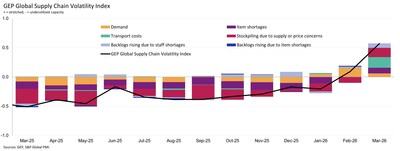
The GEP Global Supply Chain Volatility Index soared from 0.09 in February to 0.57 in March, its highest level since January 2023.
In March, global manufacturers increase safety stockpiling in response to maritime disruption, higher transportation costs and supplier price increases. Reports of inventory buffers being accumulated were the highest in three years, with increases across all major regions.
Uncertainty resulting from the conflict weighed on manufacturers' input demand, with factories around the world cutting purchasing volumes. Notably, item shortages hit a three-year high despite slowing demand, signaling the emergence of bottlenecks, with the availability of materials such as polymers, PVC and rubber, as well as energy-intensive metals such as aluminum and copper reportedly deteriorating the most.
Surging oil prices pushed global transportation costs to a four-year high in March. The impact was felt globally, but especially strongly in Asia, given its reliance on Middle East oil. Taiwan, Vietnam, South Korea and Japan reported surging producer price inflation during March.
"The war is pushing up costs, triggering stockpiling and creating shortages across supply chains, but it has not yet escalated into a broad-based shock that materially slows global economic growth," said Mukund Acharya, vice president, consulting, GEP. "Companies need to secure supply where it matters most while avoiding broad stockpiling that can lock in higher costs."
Interpreting the data:
Index > 0, supply chain capacity is being stretched. The further above 0, the more stretched supply chains are.
Index < 0, supply chain capacity is being underutilized. The further below 0, the more underutilized supply chains are.
Interpreting the data:
Index > 0, supply chain capacity is being stretched. The further above 0, the more stretched supply chains are.
Index < 0, supply chain capacity is being underutilized. The further below 0, the more underutilized supply chains are.
MARCH 2026 REGIONAL KEY FINDINGS
MARCH 2026 KEY FINDINGS
For more information, visit www.gep.com/volatility.
Note: Full historical data dating back to January 2005 is available for subscription. Please contact economics@spglobal.com.
The next release of the GEP Global Supply Chain Volatility Index will be 8 a.m. ET, May 12, 2026.
About the GEP Global Supply Chain Volatility Index
The GEP Global Supply Chain Volatility Index is produced by S&P Global and GEP. It is derived from S&P Global's PMI® surveys, sent to companies in over 40 countries, totaling around 27,000 companies. The headline figure is a weighted sum of six sub-indices derived from PMI data, PMI Comments Trackers and PMI Commodity Price & Supply Indicators compiled by S&P Global.
A Supply Chain Volatility Index is also published at a regional level for Europe, Asia, North America and the U.K. For more information about the methodology, click here.
Media Contacts
Derek Creevey | Joe Hayes | S&P Global Market Intelligence |
Director, Public Relations | Principal Economist | Corporate Communications |
GEP | S&P Global Market Intelligence | Email: Press.mi@spglobal.com |
Phone: +1 646-276-4579 | Phone: +44-1344-328-099 | |
Email: derek.creevey@gep.com | Email: joe.hayes@spglobal.com |
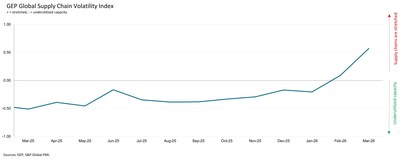
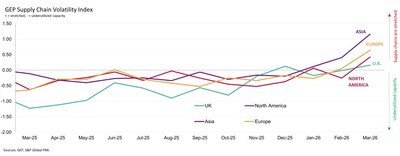

Photo - https://mma.prnewswire.com/media/2953258/GEP_SCVI_breakdown.jpg
Photo - https://mma.prnewswire.com/media/2953259/GEP_SCVI_headline.jpg
Photo - https://mma.prnewswire.com/media/2953260/SCVI_ALL.jpg
Logo - https://mma.prnewswire.com/media/518346/GEP_Logo.jpg
 View original content:https://www.prnewswire.co.uk/news-releases/middle-east-war-drives-global-supply-chain-pressures-to-a-three-year-high-gep-global-supply-chain-volatility-index-302738828.html

Schülerinnen und Schüler in Österreich, die im Rahmen der staatlichen Digitalisierungsinitiative vergünstigte Laptops oder Tablets erhalten haben, sollen künftig besser vor nicht altersgerechten Online-Inhalten geschützt werden – und zwar nicht nur im Schulnetz. Eine vom Bildungsministerium bereitgestellte neue Sicherheitskonfiguration sorgt dafür, dass Apps und Websites mit radikalen, verstörenden, sexistischen oder pornografischen Inhalten auch dann gesperrt bleiben, wenn die Geräte über öffentliche oder private WLANs etwa im Zug oder im Schnellrestaurant mit dem Internet verbunden sind. Eltern können die Voreinstellungen erweitern und zusätzliche Sperren einrichten.
Seit Ende März steht den Schulen ein zentrales Konfigurationsservice des Ressorts zur Verfügung, mit dem die Jugendschutzeinstellungen automatisiert auf die Endgeräte aufgespielt werden können. Zielvorgabe des Bildungsministeriums ist eine "schnellstmögliche Umsetzung im April". Betroffen sind alle mehr als 600.000 Laptops und Tablets, die seit 2020 im Zuge der Digitalisierungsinitiative an Schülerinnen und Schüler ausgegeben wurden. Die Eltern sollen von den einzelnen Schulen über den Ablauf und den Zeitpunkt der Umstellung informiert werden.
Mit Stichtag 1. April hatten sich nach Angaben des Ministeriums bereits 14 Prozent der Mittel- und Sonderschulen sowie der AHS-Unterstufen an den zentralen Konfigurationsdienst angebunden. Zusätzlich gibt es eine nicht bezifferte Zahl von Schulen, die die Einstellungen eigenständig nach Anleitung umgesetzt haben. Bei der technischen Umsetzung meldet das Ressort bislang einen reibungslosen Verlauf, auch die Lehrergewerkschaft berichtet nach eigenen Angaben derzeit von keinen Beschwerden im Zusammenhang mit der neuen Konfiguration.
Kern des neuen Konzepts ist ein einheitlicher "Basisschutz", der bei Bedarf durch die Erziehungsberechtigten angepasst werden kann. Über das Bildungsportal oder gemäß den Vorgaben der jeweiligen Schule lassen sich einzelne Schutzfunktionen wie Webfilter oder die Installation von Apps individuell aktivieren und deaktivieren. Wer strengere Regeln wünscht, kann mithilfe lokaler Administratorenrechte zusätzliche Schutzsoftware aufspielen, etwa um auch die Bildschirmzeit der Kinder zu begrenzen. Für Eltern, denen der vom Ministerium vorgeschlagene Webfilter beispielsweise aus Datenschutzgründen zu weit geht, ist eine Opt-out-Lösung vorgesehen, mit der sich von Teilen der Voreinstellungen Abstand nehmen lässt.